Some skills only click when someone puts the tool in your hands. YouTube tutorials can teach you technique, but they can’t tell you why your dovetail joints keep splitting or why the wood feels wrong under your fingers. This is a story about what happens when you stop watching videos and show up at an open workshop instead.
For a practical how-to on meeting teachers in public—repair cafés, library maker nights, and low-pressure ways to ask—see how to find a mentor in the real world.
The Workshop That Wasn’t Working
Julian had spent two months building a bookshelf in his basement workshop. Two months. The YouTube channel he’d been following made it look simple. Measure twice, cut once. Keep your chisel sharp. Let the tool do the work.
But his chisel kept slipping. His measurements were correct but the joints wouldn’t close. The maple he’d bought online looked nothing like the wood in the videos. He’d sanded one board seventeen times and it still felt rough.
He was about to throw the whole thing in the trash when he saw someone had posted on Joiyin: “Traditional woodworking demo at my shop in Leslieville. Open workshop after. Bring your questions or just watch. Saturday 10am.”
The poster’s name was Dorothy. Her profile picture was an auto-generated avatar, same as everyone else on the app. No portfolio, no credentials, no follower count.
Julian almost didn’t go. What if she wasn’t any good? What if it was some hobbyist who’d watched the same YouTube videos he had?
But his basement smelled like failure and sawdust, so on Saturday morning he grabbed his problem board and went.
What the Old Woman Knew
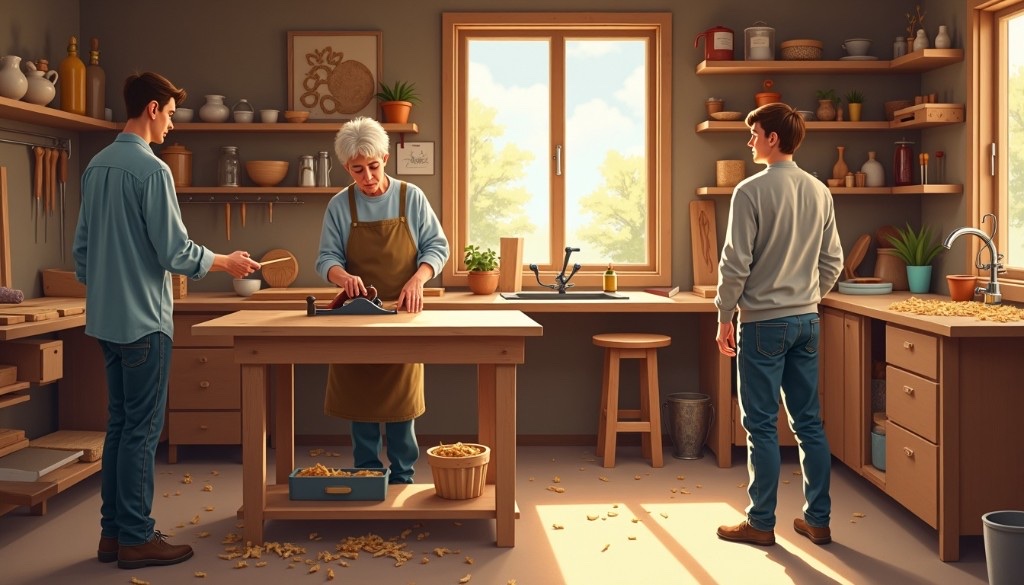
Dorothy’s workshop was in a converted garage behind a narrow house. When Julian walked in, she was planing a board at a workbench that looked older than his parents. The shavings came off in long curls, thin enough to see through.
She was maybe seventy, wearing a canvas apron covered in stains that might have been decades old. Two other people from Joiyin were already there. A younger woman named Kira with sawdust in her hair. An older guy named Victor who was running his hand along a half-finished table like he was reading braille.
“You must be Julian,” Dorothy said without looking up. “The one with the maple problem.”
“How did you know?”
“You’re carrying a board like it tried to kill you.” She set down her plane. “Let me see it.”
Julian handed it over. Dorothy held it up to the light, flipped it, ran her thumb across the grain.
“This isn’t maple.”
“The website said…”
“Website lied. This is birch. Softer. Takes a blade different. You’ve been fighting it because you thought it was something it’s not.” She handed it back. “Stop trying to make it be maple. Work with what you’ve got.”
The Things YouTube Doesn’t Teach
For the next two hours, Dorothy showed them things Julian had never seen in a video. How to read the grain before you cut. How to feel when a chisel was actually sharp versus when it just looked sharp. How to know if wood was properly dried by the weight of it in your hands.
“YouTube’s fine for basics,” Dorothy said, setting up a mortise jig. “But it can’t teach you this.” She handed Julian a piece of oak. “Feel that? The density? That’s growth rings packed tight. Twenty years of slow growth. You can’t rush that. You can’t fake it.”
Kira spoke up. “I’ve been trying to learn woodworking for a year. I can follow instructions, but I don’t understand what I’m doing wrong.”
“Because you’re following instructions,” Dorothy said. “You’re not learning the material. Wood’s not a formula. Every board’s different. You have to pay attention.”
Victor nodded. “My grandfather was a carpenter in Hong Kong. I watched him work my whole childhood, but I never asked questions. Thought I’d just know. Now he’s gone and I’m trying to rebuild his old dining table from memory.”
“Bring it next week,” Dorothy said. “We’ll figure it out together.”
What Gets Lost
At lunch, they walked to a sandwich shop around the corner. Dorothy bought a coffee and started talking about her father.
“He learned from his father, who learned from his father. German cabinetmakers. They had techniques that went back generations. My father tried to teach me, but I was seventeen and thought I knew better. Modern tools, modern methods. Faster.”
She sipped her coffee.
“Spent thirty years doing production work. Made a living. But about ten years ago, I found my father’s old tools in my mother’s basement after she died. Started trying to remember what he’d shown me. Had to relearn most of it.”
“Why do it the old way?” Kira asked. “If modern tools are faster?”
“Because the old ways knew something we forgot. They knew wood has memory. They knew patience. They knew you can’t force anything worth making.” Dorothy looked at Julian. “Your bookshelf? It’s failing because you’re trying to force it. You’re following steps, but you’re not listening to the material.”
Julian felt something click in his head. “That’s exactly what I’m doing.”
“Most people are. We think innovation means throwing out everything that came before. But real innovation? It’s taking what worked and building on it. Not starting from scratch like we invented tools yesterday.”
What Actually Changes
Julian came back the next Saturday. And the Saturday after that. Dorothy showed them joinery techniques her father had used. Kira brought a rocking chair she’d found at a garage sale. Victor brought photos of his grandfather’s table and they measured every detail.
By the fourth week, Julian’s bookshelf was finished. The joints were tight. The wood felt right. It wasn’t perfect, but it was honest work.
When Julian showed her the finished piece, Dorothy ran her hand along the shelf and said, “Innovation without foundation is just noise. Everyone wants to invent something new, dream up something impossible. But most new things fail because they ignore what came before. The stuff that survives? It serves a purpose that’s been true for a long time. It just finds a new way to do it.”
“This is good work. You learned the old ways, then made it yours. That’s how it’s supposed to go.”
Julian thought about his two months of failure in the basement. All those YouTube videos showing the steps but never explaining the why. He’d been trying to transform the mundane world without understanding the world he was working with.
“I couldn’t have figured this out from a screen,” he said.
“No,” Dorothy agreed. “Some things you need hands for. And someone who remembers.”
What the garage remembered
The people who can help aren’t always building personal brands or waiting to be discovered. They’re Dorothy, working in a converted garage, hosting open workshops for strangers from an app.
The best mentors aren’t the ones with the biggest platforms. They’re the ones who remember what almost got lost. They know that real innovation isn’t about throwing out the past. It’s about understanding what worked, why it worked, and building something new on that foundation.
Julian spent two months failing alone with YouTube videos. He learned more in two hours with Dorothy than he had in eight weeks of tutorials. Not because Dorothy was a better teacher than the internet, but because she was there. She could see his mistakes, feel his wood, answer his questions in real time.
Like the winter photo walk where a small group discovered a shared way of seeing, or the coffee meetup that turned into a habit of showing up for the same activities, real learning happens when you show up in person. When someone can put a tool in your hands and say “feel that?”
You can’t learn everything from a screen. Some knowledge only passes from person to person, in real time, with real materials. That’s what gets lost when we forget that the old ways knew something we’re still trying to remember.
Finding Your Teacher
Maybe you’re trying to learn guitar and you’ve hit a wall. Maybe you want to learn to sew, or cook real bread, or fix your own bike. Maybe you’re teaching yourself from videos and something’s not clicking.
The person who can help you might be posting an activity right now. Not a certified instructor with a website and a waiting list. Just someone who knows the thing you’re trying to learn, and remembers what it’s like to struggle with it.
Real teaching isn’t always about credentials. It’s about showing up when someone says “I’m doing this thing on Saturday if anyone wants to watch or try.” It’s about bringing your failed attempt and saying “I don’t know what I’m doing wrong.”
Dorothy didn’t advertise herself as a master woodworker. She just posted a workshop on Joiyin because she wanted company while she worked. Julian showed up because he was desperate. Victor came because he missed his grandfather. Kira came because she was curious.
That’s how it works. You show up for the activity. The learning happens because you’re there, in person, with someone who knows something you don’t. Like the old ways knew: some things only pass from hand to hand.
Post an activity. Join one. Bring your questions. For step-by-step places to look and how to ask, read how to find a mentor in the real world. Learn more about how Joiyin works or download the app to find the people who remember what you’re trying to learn.
This is a fictional story inspired by the kinds of learning and mentorship Joiyin makes possible. Have your own story about finding a mentor or learning a forgotten skill? We’d love to hear it at support@joiyin.com.